The average American household spends $519 a month on groceries, according to the BLS Consumer Expenditure Survey. That is $6,228 a year. And the USDA Food Price Outlook projects food-at-home prices will rise another 3.1% in 2026.
Most people respond by trying harder: more coupons, more store-brand swaps, more willpower at checkout. None of that is wrong. But it is also not where the real money is going.
These 15 ways to save money on groceries are ranked by realistic monthly dollar impact, not by how often they get mentioned in listicles. The ones at the top move the number. The ones at the bottom are still worth doing, just not worth starting with.
Ways to Save Money on Groceries: All 15 Ranked
Realistic monthly saving: $60 to $120 per household
The EPA estimates the average American wastes $728 per person per year on food they buy and never eat. That is $60 a month, per person, going directly in the bin. For a two-person household, that is $120 a month in food waste before a single bad spending decision is made.
This is the most overlooked way to save money on groceries because it requires no sacrifice, only attention. Before your next shop, open the fridge and write down what needs to be used this week. Build at least two meals around those ingredients. The savings are immediate.
Realistic monthly saving: $78 to $104
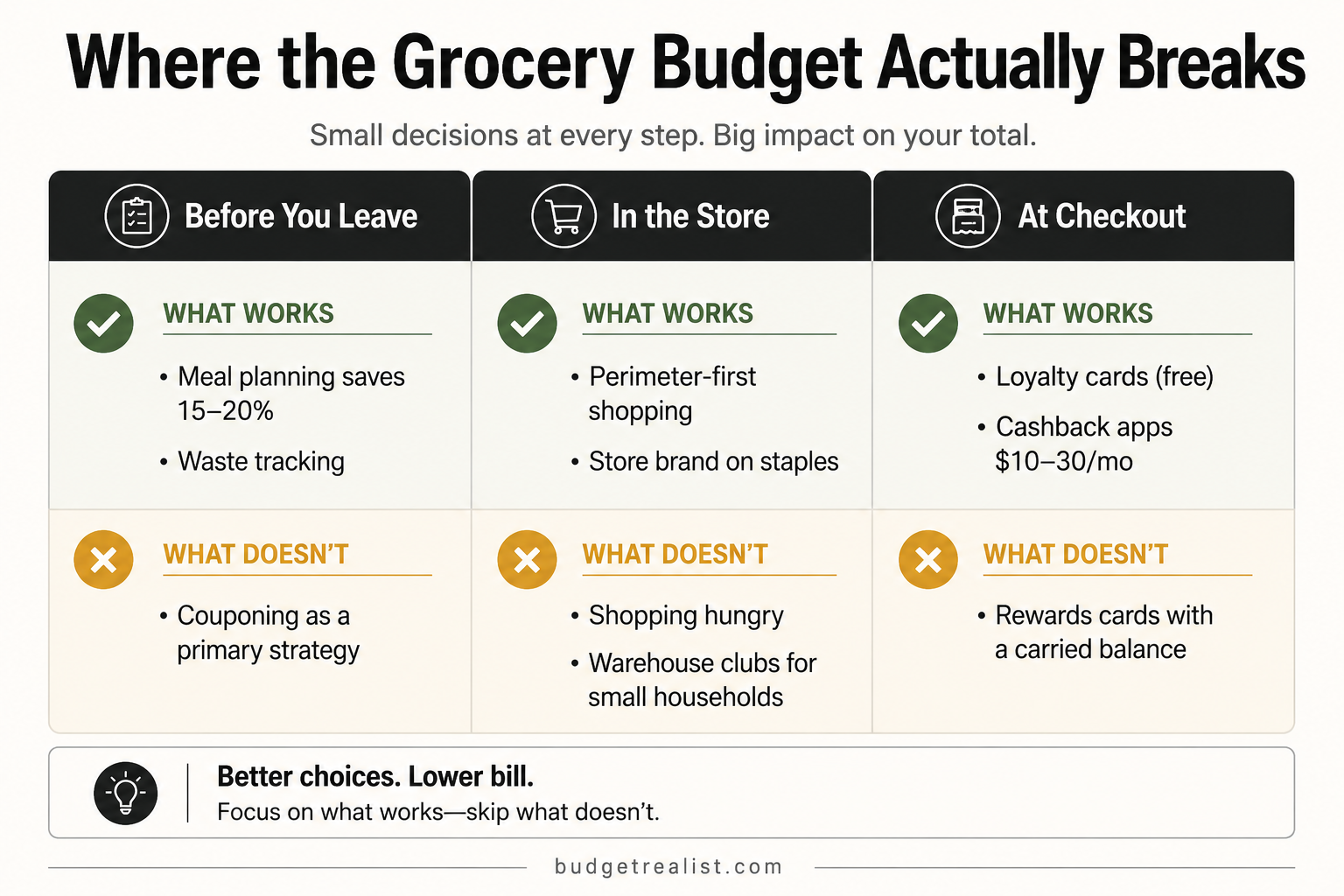
Research consistently shows that households that meal plan spend 15 to 20% less on food overall. On a $519 monthly grocery bill that is $78 to $104 a month, or roughly $1,000 a year, from one habit that takes ten minutes a week.
The mechanism is simple. Plan five dinners before writing the list. Buy exactly what those five dinners need. When you skip this step, you buy ingredients for three dinners loosely, cook two of them, and throw out everything that was supposed to become dinner three.
Before writing the shopping list, check what you already have. Build meals around what needs to be used first. This alone cuts waste by a third for most households, because half the food you buy to replace something you think you’re out of is already in the back of the cabinet.
Realistic monthly saving: $60 to $150
Store selection is the most underleveraged way to save money on groceries. Most people shop at whatever store is most convenient and never reconsider it. A 2025 Ramsey Solutions analysis found Aldi prices averaging 14 to 40% lower than conventional supermarkets on comparable items.
For staples like produce, dairy, eggs, canned goods, and frozen vegetables, Aldi is hard to beat. Most households that switch save $80 to $150 per month without changing what they eat. Walmart Grocery consistently beats traditional supermarkets on name-brand pricing and is the better option for households who want low prices without Aldi’s limited selection.
Realistic monthly saving: $30 to $80 (stops budget creep)
Most people go to the grocery store with a list but no budget. The list tells you what to buy. The budget tells you when to stop. Without a specific number in mind, every extra item feels individually reasonable and collectively expensive.
Write the number down before you leave. Track your running total as you shop. This sounds tedious and stops being tedious after three or four shops, because you develop an accurate intuitive sense of what things cost. Most people who do this for a month find they never need to tally again.
Realistic monthly saving: $30 to $60
On canned goods, pasta, rice, oils, frozen vegetables, cleaning products, and paper products, store brand quality is functionally identical to name brand in most categories. The price difference is 20 to 40% lower.
The approach that works: look at your last receipt, identify 10 items you buy every week without variation, switch those to store brand. Notice which ones you cannot tell the difference on. Keep those switches permanently. Switch back on anything you actually care about. Within a month you have a permanent list of swaps that save $30 to $60 every shop with no real compromise.
Realistic monthly saving: $20 to $50 (blocks impulse spending)
The perimeter of most grocery stores is produce, meat, dairy, and bread. These are whole ingredients. The interior aisles are mostly processed and packaged goods, which carry significantly higher margins for the store and significantly lower nutritional density for you.
Shop the perimeter first, with your list. Go into the interior aisles only for specific items you planned for. Getting what you need from the perimeter before entering the aisles means you have already filled most of the cart with intentional purchases before you hit the most heavily marketed products in the store.
Realistic monthly saving: $15 to $40
Every major grocery chain has a free loyalty card that unlocks member pricing. If you shop at Kroger, Safeway, Albertsons, or any regional chain and you are not using their loyalty program, you are paying the non-member price on dozens of items every shop. The sign-up takes two minutes and the savings are immediate.
Kroger’s loyalty program includes fuel points on top of grocery discounts. Safeway’s Just for U program personalizes offers based on what you actually buy. These are not gimmicks. They return real money on items you were already buying.
Realistic monthly saving: $10 to $30
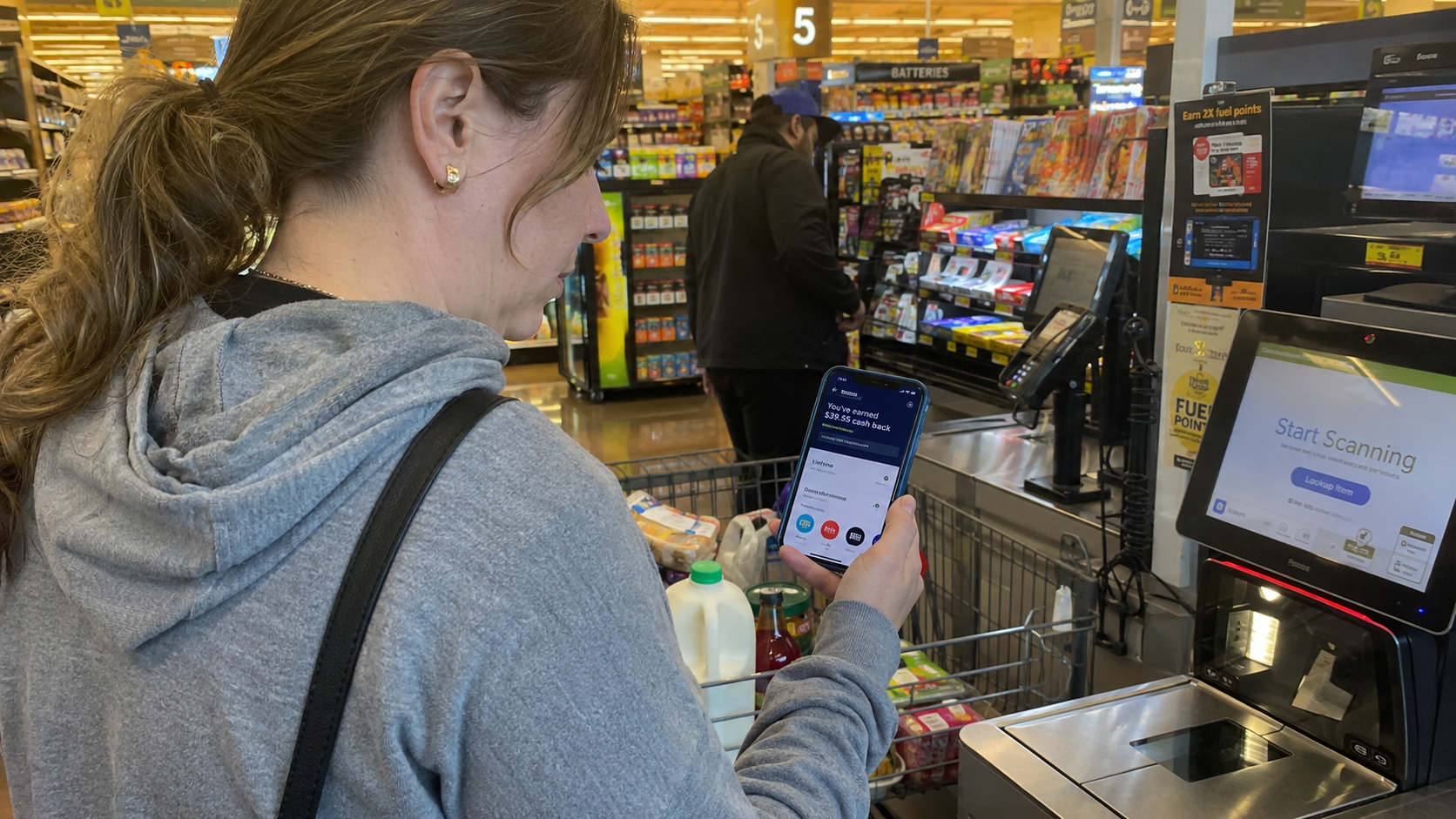
Ibotta and Fetch are the two worth using. Ibotta works by activating offers before shopping and scanning receipts after. Fetch gives points on any receipt from any store, redeemable for gift cards. Both can realistically return $10 to $30 a month on a normal grocery run with zero change to what you buy.
The rule applies strictly: only activate offers for things already on your list. The moment you buy something because there is a cashback offer on it, you have turned a saving into a spending trigger.
Realistic monthly saving: $15 to $40 (stops hunger impulse buys)
This is not a wellness tip. It is a financial one. Studies consistently show people buy more calories, more impulse items, and more expensive convenience foods when shopping hungry. A $12 rotisserie chicken that was not on the list because you smelled it walking past the deli is a $12 leak that no coupon will recover.
Eat before you shop, every time. It is one of the simplest ways to save money on groceries with zero ongoing effort.
Realistic monthly saving: $15 to $35
Frozen vegetables are picked and frozen at peak ripeness, which means nutritional content is comparable or better than fresh produce that has been sitting in transit and on shelves for days. The price per serving is significantly lower, and there is no spoilage.
Fresh vegetables make sense where texture matters, like salads and crudites. For everything cooked, soups, stir fries, casseroles, pasta dishes, frozen is functionally identical and meaningfully cheaper. Switching half your vegetable buying to frozen saves $15 to $35 a month for most households.
Realistic monthly saving: $20 to $50
Lunch is where grocery budgets bleed quietly. Buying sandwich ingredients, snacks, and convenience lunch items for five days a week adds up fast and produces a disproportionate amount of waste because people’s lunch habits are inconsistent.
Cook slightly more at dinner. Eat it for lunch the next day. This eliminates an entire shopping category and reduces the likelihood of grabbing something expensive because there is nothing easy at home. For a two-person household, this saves $20 to $50 a month without any meaningful sacrifice.
Realistic monthly saving: $5 to $20
Coupons are not bad. But they are the wrong thing to optimize for when you are trying to cut your grocery bill meaningfully. A 50 cent coupon on a $4 item saves 12.5%. Finding out you already have two of that item at home saves 100%.
Coupons reward buying more of things. Most grocery budgets are already buying too much of things. Use coupons only on items that are on your list anyway. Do not let them dictate the list. That is the line between saving and spending.
Tariffs on imported goods in 2026 are pushing above-trend price increases on coffee, cocoa, tropical fruits, and some seafood. If those are staples in your household, expect your grocery bill to feel higher than the USDA benchmarks suggest, and prioritize substitutes where you can.
Realistic monthly saving: $15 to $40
Organic produce costs 20 to 100% more than conventional for nutritionally comparable food. If budget is the primary concern, conventional is the right choice across the board. If you have strong preferences about specific items, buy organic selectively on those and conventional on everything else.
Most people who audit their organic buying find three or four items they genuinely care about and a dozen they were buying out of habit. Keeping the three, dropping the dozen, saves real money with no real sacrifice.
Realistic monthly saving: $10 to $30 (when used correctly)
Costco and Sam’s Club are genuinely cheaper per unit on many items. But the savings only materialize if you actually use what you buy before it expires. A 5lb bag of spinach is not cheaper per ounce if you throw out 3lbs of it.
Bulk buying makes sense for: non-perishables you go through reliably, paper products, canned goods, rice, pasta, cooking oil, and households of three or more people. It does not make sense as a general grocery strategy for smaller households or for anything perishable that exceeds your realistic weekly consumption.
Realistic monthly saving: $20 to $40
Most households have $50 to $100 worth of food sitting in their pantry at any given time that never gets used because it gets pushed to the back and forgotten. The pattern that shows up constantly: buying a second jar of something you already had, or buying ingredients for a recipe you never cooked and never will.
Once a month, before the first major shop, do a full pantry and freezer audit. Write down everything. Build two or three meals entirely from what you find. Then shop only for what those meals are missing plus your weekly list. One habit, once a month, consistently returns $20 to $40 in food you would have otherwise replaced.
All 15 Ways to Save Money on Groceries: Dollar Impact at a Glance
| Tactic | Monthly Saving | Effort |
|---|---|---|
| Reduce food waste | $60 to $120 | Low |
| Meal planning | $78 to $104 | Low (10 min/week) |
| Switch to Aldi or Walmart | $60 to $150 | One-time decision |
| Set a dollar limit before leaving | $30 to $80 | Low |
| Store brand on 10-15 staples | $30 to $60 | None once habit forms |
| Shop perimeter first | $20 to $50 | None |
| Loyalty card | $15 to $40 | One-time setup |
| Cashback apps (Ibotta, Fetch) | $10 to $30 | Low |
| Eat before shopping | $15 to $40 | None |
| Frozen veg instead of fresh for cooking | $15 to $35 | None |
| Leftovers for lunch | $20 to $50 | Low |
| Coupons on list items only | $5 to $20 | Low |
| Skip organic selectively | $15 to $40 | One-time audit |
| Selective bulk buying | $10 to $30 | Medium |
| Monthly pantry audit | $20 to $40 | Low (once/month) |
Running all 15 together, a typical household can realistically save $200 to $350 per month on groceries. That is not a coupon strategy. That is a system where every habit compounds on the last one.
How to Actually Use These Ways to Save Money on Groceries
Do not try to implement all 15 in the same week. That is how grocery saving projects become abandoned grocery saving projects.
Start with the top three: reduce waste, meal plan, and switch your primary store. Those three alone move most households $150 to $200 per month before anything else changes. Once those are running automatically, layer in the store brand swaps, the loyalty card, and the cashback apps.
By the time all 15 habits are in place, you are looking at a fundamentally different relationship with the grocery store. Not a tighter one, a smarter one.
The Ways to Save Money on Groceries That Actually Move the Number
Waste reduction and meal planning are where the real money is. Everything else is optimization on top of a foundation that either exists or doesn’t. Get those two right first, then build the rest of the system around them.
The grocery bill is one of the fastest-moving levers in a household budget because it is a recurring expense with compounding returns. Every week you run the system, you save again. Every week you do not, you do not.
If you want to go deeper on the store selection decision, this breakdown of the 4 decisions that cut your grocery bill covers the framework behind where to shop and how to benchmark your spending against USDA data. And if the grocery bill is part of a bigger budget problem, this guide to cutting monthly expenses covers the full picture.